Arabic English Website Design in Dubai: RTL and SEO Done Right
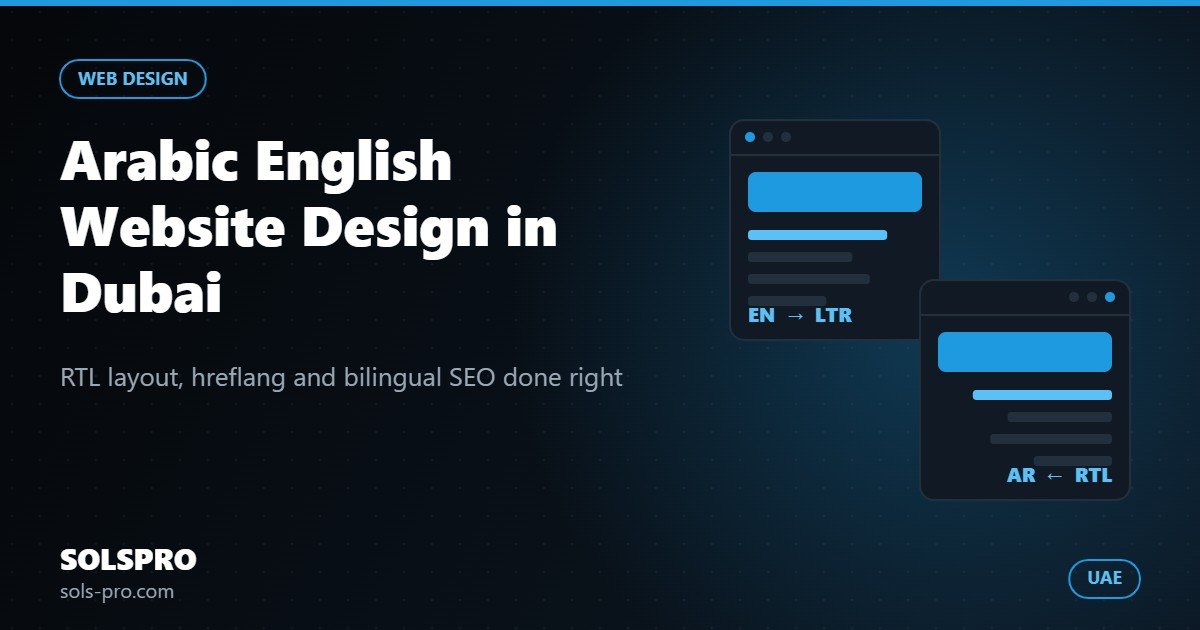
Arabic English website design in Dubai is more than translating your pages. A bilingual site needs a right-to-left (RTL) layout for Arabic, separate URLs for each language, correct hreflang tags and content written for how people actually search in each language. Get these right and both your Arabic and English pages can rank; get them wrong and Google may show the wrong version, or neither.
Why Do Dubai Businesses Need Arabic English Website Design?
The UAE audience is mixed. Many customers browse in English, while government bodies, local partners and many Arabic-speaking customers prefer Arabic. A bilingual site lets you serve both, builds trust with Arabic-speaking clients and lets your business appear in Arabic search results as well as English ones.
What Changes in an RTL Layout?
Arabic reads from right to left, so the whole interface has to mirror, not just the text. Key points:
- Set
dir="rtl"andlang="ar"on the Arabic pages so browsers and screen readers handle them correctly. - Mirror the layout: navigation, sidebars, breadcrumbs, progress steps and arrows flip direction.
- Do not mirror everything: logos, phone numbers, product photos, video controls and charts usually stay as they are.
- Use CSS logical properties (margin-inline-start instead of margin-left) so one stylesheet works for both directions.
- Choose a proper Arabic web font and allow more line height, as Arabic script needs room for its shapes.
- Test forms carefully: mixed Arabic text with English emails, numbers and URLs can display in unexpected order.
How Should Bilingual URLs Be Structured?
Each language should have its own crawlable URL. The most common and easiest setup is subfolders on one domain, for example /en/ and /ar/. This keeps all your authority on a single domain. Avoid switching language with cookies or JavaScript only, because Google may never see the Arabic version.
Keep the language switcher on every page, and link each page to its exact translation, not to the homepage of the other language.
How Do You Set Up Hreflang for Arabic and English?
Hreflang tags tell Google which version to show to which user. A typical UAE setup includes:
hreflang="en-AE"or"en"for the English page.hreflang="ar-AE"or"ar"for the Arabic page.hreflang="x-default"for the fallback version.
Every page must list itself and its alternate, and the tags must be reciprocal. Each version should also have a self-referencing canonical tag. Pointing the Arabic canonical at the English page is a common mistake that removes the Arabic page from search.
Arabic SEO: What Is Different?
Arabic SEO is its own piece of work, not a translation of your English keywords. People may search in Modern Standard Arabic, in Gulf dialect, or in "Arabizi" (Arabic written in Latin letters). Spelling variations are also common. Research Arabic keywords separately and write titles, meta descriptions and headings natively for each language.
Avoid publishing raw machine translation. It reads poorly, hurts conversions and can look like low-quality content. Use a fluent Arabic writer or editor, at least for your main pages.
Design and Performance Checklist
- Design both versions in the mock-up stage, not Arabic as an afterthought.
- Check text length: Arabic and English lines differ, so buttons and menus need flexible widths.
- Keep images free of embedded text, or create separate versions per language.
- Load only the font weights you use, since Arabic fonts can be large.
- Translate structured data, image alt text, form messages and error pages too.
- Submit both language versions in your XML sitemap.
If you are still comparing agencies for this kind of project, our guide on choosing a web development company in Dubai and the UAE lists the questions to ask.
How SOLSPRO Builds Bilingual Websites
SOLSPRO is a Karachi-based team that designs and develops business websites with SEO built into the structure from the start. For bilingual sites we plan the RTL layout, URL structure and hreflang setup before design begins. For UAE clients we work remotely with overlapping hours, as the UAE is just 1 hour behind Pakistan. See our website development services and how we support businesses in Dubai and the UAE.
Frequently Asked Questions
Should I use a separate domain for my Arabic website?
Usually not. Subfolders such as /ar/ on your main domain are simpler to manage and keep your SEO strength in one place.
Can I just add a translation plugin?
Automatic translation widgets often do not create crawlable Arabic pages, and the quality is weak. For SEO and trust, use proper Arabic pages with their own URLs.
Do I need different keywords for the Arabic pages?
Yes. Arabic searchers use different terms and spellings, so research and write Arabic keywords separately rather than translating English ones word for word.
Plan Your Bilingual Website With SOLSPRO
Planning an Arabic English website for your Dubai business? Talk to us about a bilingual design that looks right in both directions and is built to rank. Contact us, call (021) 3438 0297 / +92 21 3438 0297, or message us on WhatsApp at +92 324 2372699.