How to Build a Multi-Vendor Marketplace: Apps, Dashboards and What Drives the Cost
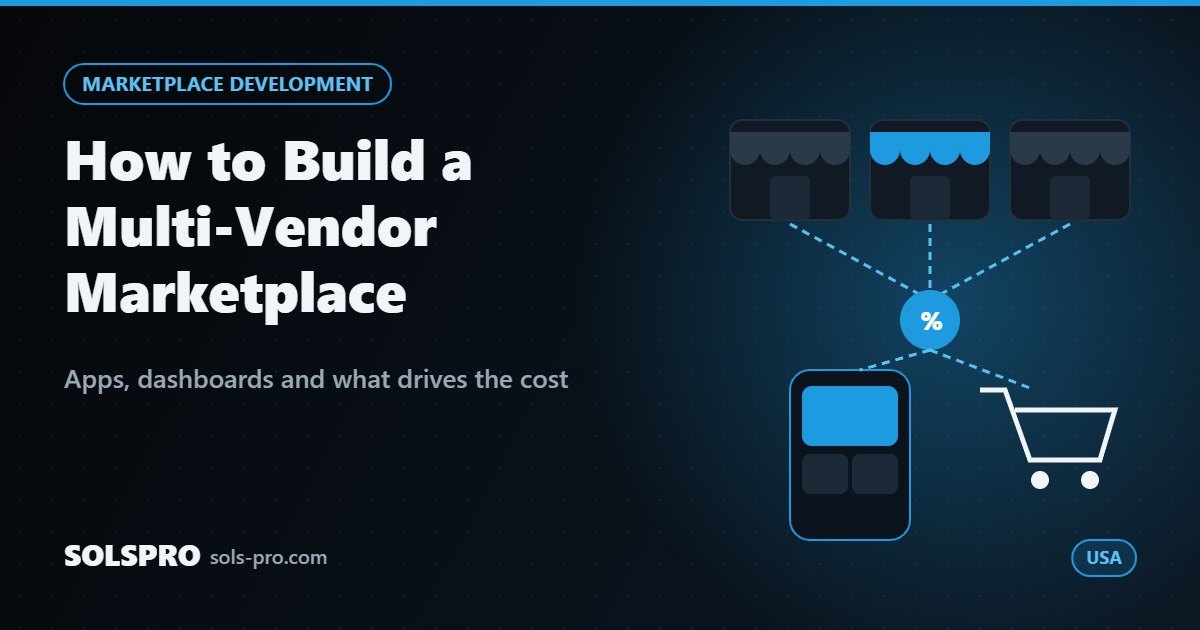
A multi-vendor marketplace looks simple from the outside: shoppers browse, sellers list products, the platform takes a cut. Underneath, it is three products that must work as one. Founders in the USA, the UK and the Middle East often underestimate this and run out of budget halfway through. This guide explains what multi-vendor marketplace development actually involves, what to build first, and which decisions drive the cost, using a marketplace SOLSPRO built as an example.
The three parts of every marketplace
1. The shopper app or website
This is what customers see: search, categories, product pages, offers, saved items, cart, checkout, order tracking and their account. It can be a mobile app, a website or both. Most marketplaces now start with a mobile app or a mobile-first website, because that is where shoppers spend their time.
2. The vendor dashboard
Sellers need their own space to add and edit products, manage stock, accept and fulfil orders, see payments and payouts, and update bank details. If this dashboard is slow or confusing, vendors stop updating listings and the marketplace quickly looks abandoned. Treat vendors as users who deserve good design, not an afterthought.
3. The admin panel
The marketplace team approves vendors, moderates listings, sets commissions, handles disputes and refunds, manages categories and promotions, and watches the numbers. A good admin panel is what lets a small team run a large marketplace.
In the e-commerce platform SOLSPRO built, vendors run product management, order management, payment tracking and bank accounts from a web dashboard with earnings and order charts, while shoppers use a mobile app with search, categories, offers, new arrivals, saved items and cart. Both share the same data, so what a vendor publishes is exactly what a shopper sees. The app even switches between shopping for products and hiring professionals, which shows how one platform can carry more than one kind of listing.
Payments and payouts: the hardest part to get right
A marketplace collects money from shoppers and pays vendors after taking its commission. That raises questions you should answer before development starts:
- Split payments or manual payouts? Some payment providers can split each payment automatically between the platform and the vendor. Others require you to collect everything and pay vendors on a schedule.
- When do vendors get paid? On delivery, after a return window, weekly or monthly.
- How are refunds handled? Who carries the cost, and how is it deducted from future payouts?
- Which currencies and countries? This decides which payment providers you can use.
Pick a payment provider that supports marketplaces in your target countries early. Changing it later is expensive.
Features worth building first
A first version should prove that vendors will list and shoppers will buy. For most marketplaces that means:
- Vendor sign-up with admin approval
- Product listings with photos, variants and stock
- Search, categories and filters
- Cart, checkout and one payment method
- Order status for shoppers and vendors, with notifications
- Commission settings and a payout report
- Basic admin: vendors, products, orders, refunds
Features that can wait
- Reviews and ratings (useful once there is enough volume)
- Chat between shoppers and vendors
- Coupons, loyalty and referral programmes
- Advanced analytics for vendors
- Multiple languages and currencies
- Delivery tracking integrations
Every one of these adds design, development and testing. Launching without them and adding the ones users ask for is almost always cheaper and faster.
What drives the cost
There is no fixed price for a marketplace, but the same factors decide every estimate:
- Platforms. Mobile app only, website only, or both, and whether the app is cross-platform or native.
- Number of user roles. Shopper, vendor and admin at minimum; delivery riders or service professionals add more.
- Payment complexity. Split payments, multiple currencies, refunds and payout schedules.
- Integrations. Couriers, accounting, SMS and WhatsApp, inventory systems.
- Design depth. A clean standard design versus a highly branded custom experience.
- Scale expectations. How many vendors, products and orders the first version must handle.
Ask any development team to break their estimate down by feature and by user role. That makes it easy to move items to a later phase without losing what matters.
Build from scratch or use a template?
Marketplace plugins and templates can get a simple marketplace online quickly. They struggle when you need a mobile app that shares data with the vendor dashboard, custom commission rules, unusual listing types such as services, or a vendor experience that feels like your own brand. A custom build costs more up front but gives you a product you control and can grow. See how we approach e-commerce and marketplace development.
Building a marketplace with an offshore team
Many US founders build their marketplace with an offshore team to make the budget go further. The keys are a clear first-version scope, regular test builds and full ownership of the code and accounts. Our guide to offshore app development for US businesses covers how to make that work, and our page for US clients explains how we work across the time difference.
Talk to SOLSPRO about your marketplace
SOLSPRO designs and builds marketplaces, shopping apps and vendor dashboards for founders and businesses in the USA, the UK, the UAE, Qatar and Pakistan. Send us a short description of your idea, call +92 21 3438 0297 or WhatsApp +92 324 2372699, and we will reply with questions and a suggested first version.
Frequently asked questions
Do I need a mobile app and a website for my marketplace?
Not at first. Many marketplaces launch with a mobile app or a mobile-first website for shoppers and a web dashboard for vendors, then add the other platform once demand is clear.
How do marketplaces make money?
Usually through a commission on each sale, and sometimes through vendor subscription fees, paid listings or featured placements. Your commission model should be decided before payments are built.
Can a marketplace sell both products and services?
Yes. The platform needs different listing types and booking or quote flows for services, as in the marketplace we built where shoppers switch between shopping for products and hiring professionals.