Flutter vs Native App Development: Which Is Right for Your Business App?
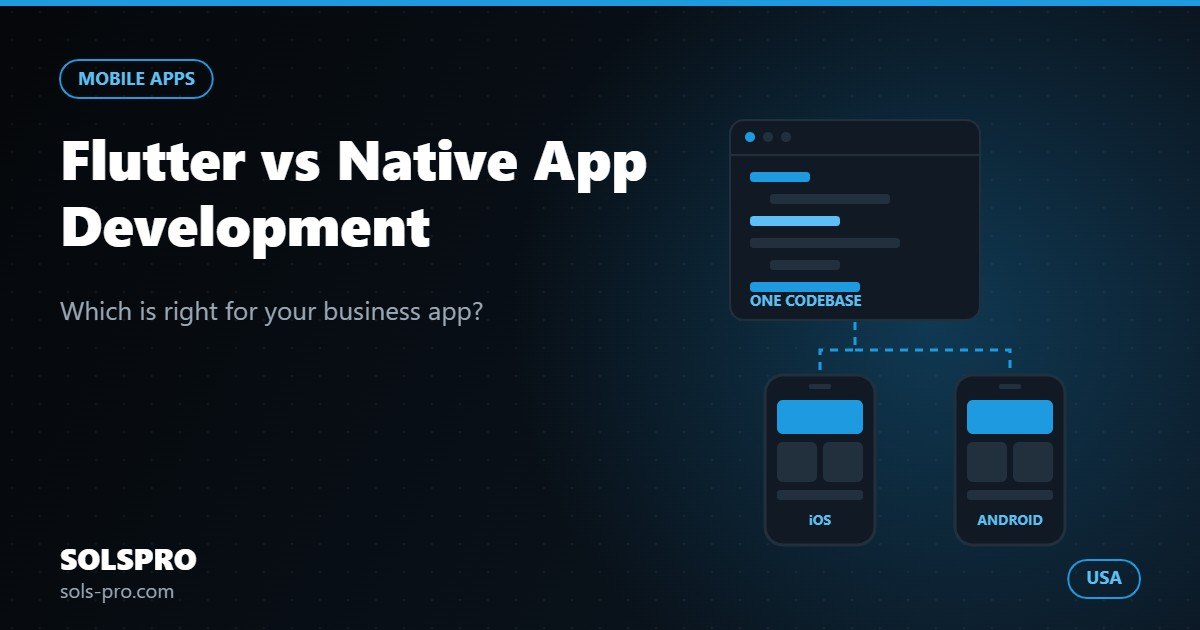
Choosing between Flutter vs native app development comes down to one question: do you need one app that runs well on both iPhone and Android with a single budget, or do you need the deepest possible access to each platform? For most business apps, such as booking, ordering, field service or customer portals, Flutter is the faster and more cost-effective route. Native development makes more sense when the app depends heavily on device hardware, platform-specific features or very demanding graphics.
What Is the Difference Between Flutter and Native Apps?
Native apps are built separately for each platform: Swift (or Objective-C) for iOS and Kotlin (or Java) for Android. You end up with two codebases, often two developers or teams, and two sets of releases.
Flutter is Google's open-source framework for building apps from a single codebase written in the Dart language. The same code produces an iOS app and an Android app, and Flutter draws its own interface rather than relying on each platform's built-in components. That is why Flutter apps look consistent on every device.
Flutter vs Native App Development: Side-by-Side
| Factor | Flutter | Native (Swift + Kotlin) |
|---|---|---|
| Codebases | One shared codebase | Two separate codebases |
| Build time | Usually shorter, features built once | Longer, features built twice |
| Budget | Lower for most business apps | Higher, two platforms to build and maintain |
| Performance | Smooth for typical business apps | Best for heavy graphics and hardware use |
| New OS features | Sometimes need plugins or custom native code | Available as soon as Apple or Google release them |
| Maintenance | One team, one release cycle | Two release cycles to keep in sync |
When Is Flutter the Right Choice?
Flutter is a strong fit when you want to reach both iPhone and Android users from day one without doubling the work. It suits:
- Booking and appointment apps for salons, clinics and service businesses.
- Ordering and shopping apps connected to a web dashboard.
- Customer portals, loyalty apps and membership apps.
- Internal apps for sales teams, field staff and warehouses.
- MVPs where speed to market matters more than platform-specific polish.
A shared codebase also means bug fixes and new features reach both app stores at the same time, which keeps support simpler for a small business.
When Should You Go Native?
Native development is worth the extra effort when the app's core value depends on something Flutter handles less directly:
- Heavy use of device hardware, such as advanced camera processing, Bluetooth accessories or sensors.
- Complex animations, 3D, AR or game-like graphics.
- Deep integration with platform features like widgets, watch apps or car integrations.
- Apps where you only need one platform anyway, for example an iOS-only product.
Flutter can still access native features through plugins or small pieces of platform code, so this is rarely all-or-nothing. A good team will tell you early if a feature needs native work.
How Do Cost and Timeline Compare?
We do not quote fixed prices in articles, because cost depends on screens, integrations, backend work and design. What drives the difference is simple: native means building and testing most features twice. With Flutter, the app's logic and interface are written once, so the same scope usually takes less time and fewer developer hours. The backend, admin dashboard and API work cost the same either way.
What Do US Businesses Usually Choose?
Many US startups and small businesses start with Flutter to launch on both stores quickly, validate the idea and gather real user feedback. If the product later needs platform-specific features, those parts can be added natively. Larger companies with dedicated iOS and Android teams often stay native. If you are planning to work with an offshore team, our guide on offshore app development for US businesses explains how to set up the process.
How SOLSPRO Approaches Business Apps
SOLSPRO is a Karachi-based team that builds mobile apps with the dashboards and backends behind them. One example is our vendor dashboard and shopping app platform, where the customer app, vendor dashboard and admin tools work together. We recommend Flutter or native after looking at your features, not by default. For US clients we work remotely with overlapping hours, as US Eastern time is 9 to 10 hours behind Pakistan. Learn more about our mobile app development services and how we work with businesses in the USA.
Frequently Asked Questions
Is Flutter good enough for a production business app?
Yes. Flutter is used for production apps across many industries. For typical business features like forms, lists, payments, maps and notifications, most users will not notice a difference from native.
Can a Flutter app be converted to native later?
It would need to be rebuilt for each platform, but your backend, APIs, designs and business logic can be reused. Many teams keep Flutter and add native modules only where needed.
Is React Native an alternative to Flutter?
Yes. React Native is another cross-platform option that uses JavaScript. Both work well for business apps; the right choice often depends on your existing team and tech stack.
Plan Your App With SOLSPRO
Not sure whether Flutter or native fits your app? Share your idea and we will recommend the right approach with a clear scope. Contact us, call (021) 3438 0297 / +92 21 3438 0297, or message us on WhatsApp at +92 324 2372699.