Custom CRM Development in Qatar: When It Beats Off-the-Shelf Software
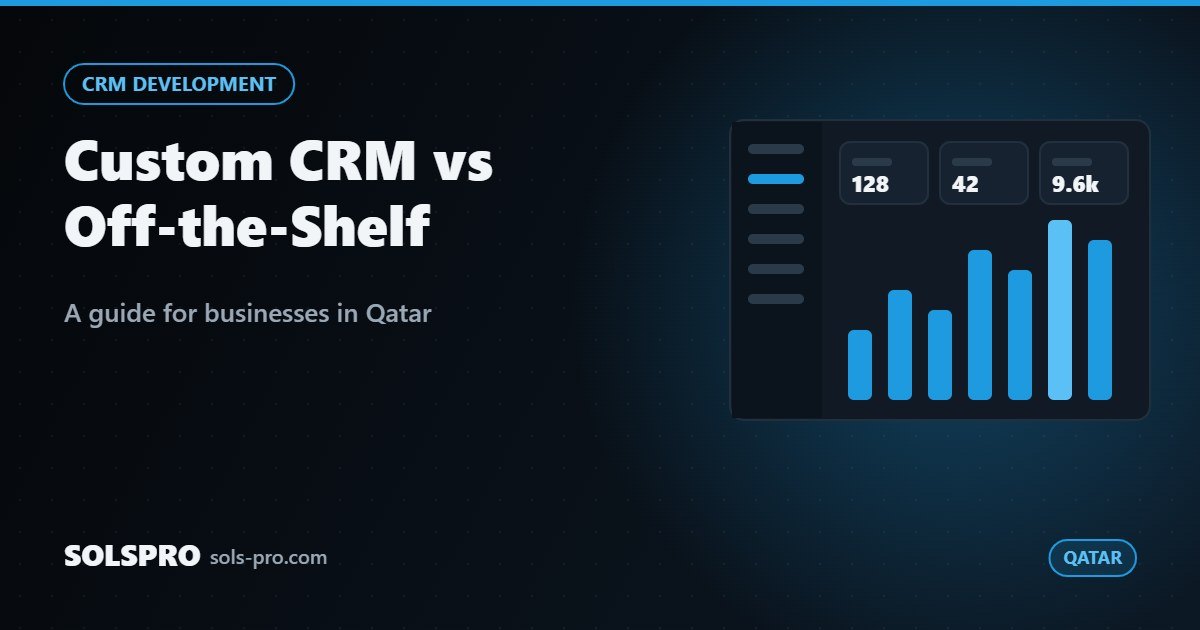
Most growing businesses in Doha reach the same point. Leads arrive by WhatsApp, phone, email and walk-ins. Quotes live in spreadsheets. Follow-ups depend on someone remembering. A CRM fixes this, but which kind? You can subscribe to a ready-made platform, or have a CRM built around how your company works. This guide helps Qatar businesses decide, with the honest trade-offs on both sides.
What a CRM should do for you
Whatever you choose, a CRM should give you:
- One list of every lead and customer, with full history.
- Clear stages for each deal, so nothing sits forgotten.
- Reminders and tasks for follow-ups.
- Quotes, invoices and payment status linked to the customer.
- Reports that show where sales come from and where they get stuck.
When an off-the-shelf CRM is the right choice
Ready-made platforms are a good fit when:
- Your sales process is fairly standard: lead, quote, close.
- You have a small team and want to start this month.
- You are happy to adjust your process to the software.
- The monthly per-user fee stays affordable as you grow.
The catch is that per-user subscriptions add up as your team grows, many useful features sit in higher plans, and the software rarely matches local workflows exactly.
When a custom CRM makes more sense
A custom CRM is worth considering when one or more of these is true:
Your process is not standard
Contracting, trading, recruitment, real estate, clinics and service companies in Qatar often have steps that generic tools do not handle: site visits, approvals, sponsor or client documents, delivery schedules, project milestones. Forcing these into a standard CRM usually ends with staff going back to spreadsheets. Clinics and spas, for example, usually need bookings and reminders built in; our guide to clinic booking software in Qatar covers the features that cut no-shows.
You need sales, operations and finance in one place
Many Qatar businesses want more than sales tracking. They want inventory, purchasing, invoicing, staff, payroll and reports in the same system. That is closer to an ERP, and a custom build lets you connect exactly the modules you use.
You need Arabic and English
Some teams and customers work in Arabic, others in English. A custom system can show the interface and documents such as quotes and invoices in both, with right-to-left layouts done properly.
You want to own the system and the data
With a custom CRM you own the code and decide where your data is hosted. There is no per-user fee that rises every year, and no risk of a vendor changing plans or removing a feature you depend on.
If you run a contracting business, see our guide to ERP for contracting companies in Qatar.
Cost: think in years, not months
An off-the-shelf CRM looks cheaper because the first month is small. A custom CRM has a larger upfront cost and lower running costs. The fair comparison is total cost over three to five years: subscription fees for every user and add-on, versus development plus hosting and support. For a team of a few people, subscriptions usually win. For larger teams, or companies that need several modules, a custom system often costs less over time and fits far better.
Features worth asking for in a custom CRM
- Lead capture from your website forms and WhatsApp.
- Customer profiles with documents, notes and full history.
- Pipeline view with drag-and-drop stages.
- Quotes and invoices in QAR, with partial payments and balances.
- Role-based access, so staff see only what they need.
- Dashboards for owners: today, this week, this month.
- Mobile-friendly screens for sales staff in the field.
- Light and dark mode, notifications and reminders.
How to brief a CRM developer
- Write down how a sale happens today, step by step, including who does what.
- List the documents and reports you produce every week.
- Mark which features you need at launch and which can come later.
- Say which tools the CRM must connect to: website, accounting software, email, WhatsApp.
- Agree on hosting, backups, support hours and who owns the code.
What SOLSPRO has built
SOLSPRO designs and develops custom CRM and ERP systems shaped around how a business already works. Our case studies include a salon CRM that runs bookings, staff, products and expenses; a retail CRM with point of sale, inventory, returns and a money ledger across several businesses; a vendor platform with a matching mobile app; and the CRM we use to run our own agency, covering invoices, projects, payroll and finance.
Our team works from Karachi, two hours ahead of Doha, so our working days overlap almost entirely with yours. See how we work with businesses in Qatar. If you are weighing up a CRM, tell us how your team works today or WhatsApp us at +92 324 2372699, and we will suggest whether a custom build or an existing tool is the better fit.
Frequently asked questions
How long does it take to build a custom CRM?
It depends on the modules. A focused sales CRM can launch in phases within a couple of months, with extra modules such as inventory or payroll added afterwards. Building in stages lets your team start using it sooner.
Can a custom CRM support Arabic?
Yes. The interface, customer records and documents can be bilingual, with right-to-left layout for Arabic screens.
Can we move our existing data into a new CRM?
Usually yes. Customer lists, products and open invoices from spreadsheets or other software can be cleaned and imported before launch.